
What property owners should know before installing commercial EV charging
A successful charging project starts with the people using it—and the electrical infrastructure behind it.
The short answer
Decide who will charge, how long they park, and who will own and operate the equipment. Then evaluate electrical capacity, utility requirements, parking layout, site work, and ongoing costs before committing to chargers.
1. Start with the drivers and their parking time.
Are you serving employees parked for a work shift, customers making a short visit, residents, or fleet vehicles? Estimate the number of vehicles expected initially and how that may grow.
Level 2 charging often fits longer parking stays. DC fast charging serves different charging needs and usually brings greater electrical demand and infrastructure requirements. Charging performance also depends on the vehicle and equipment; advertised charger output is not a guaranteed charging rate for every vehicle.
2. Review the power before buying the chargers.
Share the proposed charger specifications and available building electrical records. The contractor and utility need to understand the planned demand and the existing supply arrangement.
Some installations can use an existing electrical system; others need distribution changes or a new service. Ask whether a phased installation or compatible load-management approach could suit your goals. That decision needs to account for charging performance as well as electrical constraints.
3. Treat the parking layout as part of the electrical project.
Provide a site plan showing preferred spaces, drive aisles, sidewalks, landscaping, and known utilities. Think about how vehicles approach and park, how cables reach vehicles, and how equipment can be accessed for maintenance.
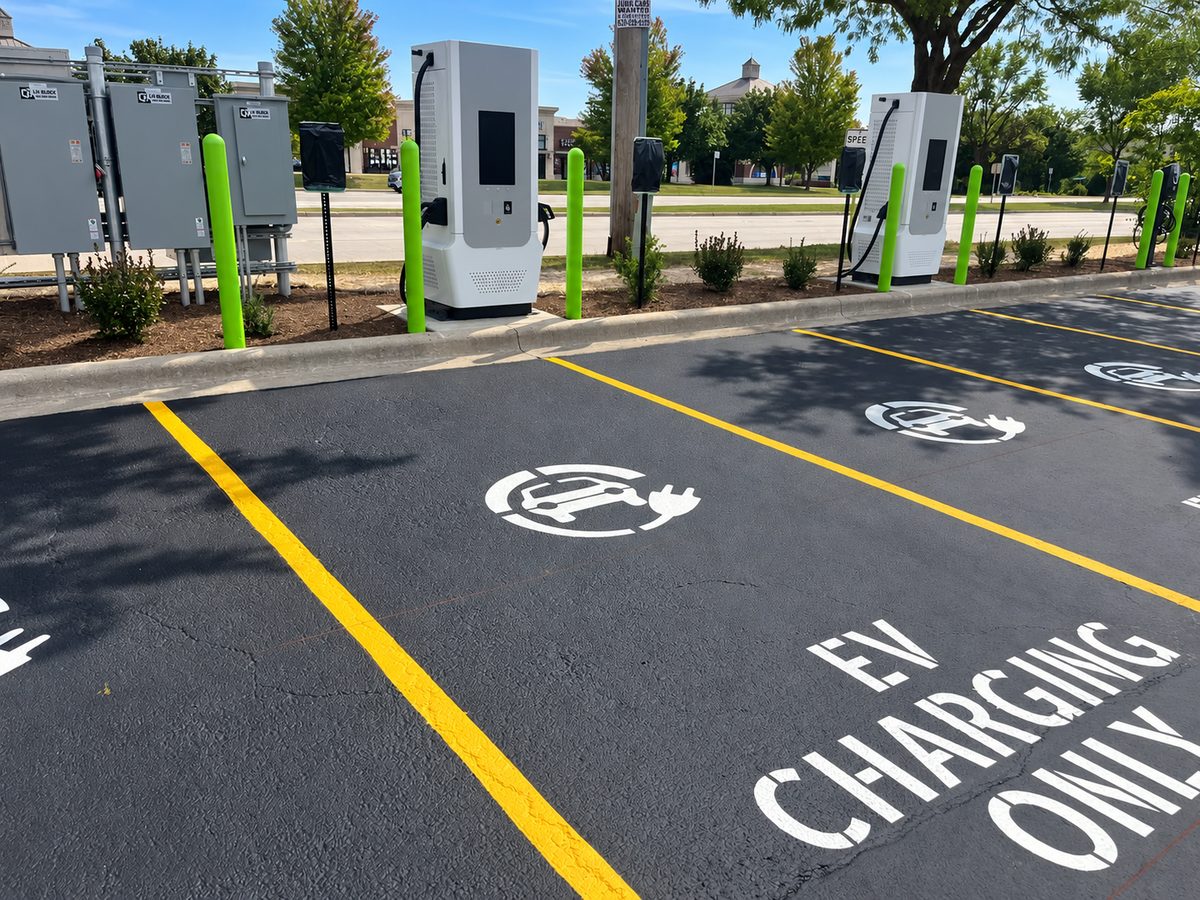
Coordinate accessibility, equipment protection, signage, drainage, and snow-removal needs with the design team and applicable local requirements. The most convenient parking spot is not always the simplest location to power.
4. Include the work beneath and around the chargers.
Service equipment, utility transformer provisions, underground conduit, foundations, bollards, trenching or boring, and pavement restoration can form a substantial part of the scope. The charger itself is only one component.
Discuss utility coordination, inspection steps, equipment availability, weather, and access before choosing an opening date. Share any restrictions on closing parking spaces or interrupting the businesses on the property.
5. Decide who owns the operating responsibilities.
Identify who purchases the equipment, sets pricing, pays for electricity, manages the charging network, and responds when a driver needs help. Ask the supplier about connectivity, payment processing, subscriptions, warranties, and repair support.
Clarify startup and commissioning responsibilities separately from electrical installation. On the Sycamore project, LH Block installed the charging equipment while others performed startup and commissioning. Make these responsibilities clear in your own project scope.
6. Budget for operation and future growth.
Ask the utility about the applicable rate and how charging demand may affect ongoing electric costs. Include network fees, maintenance, and any owner responsibilities when evaluating the investment.
If additional chargers are likely, discuss whether pathways or space for future equipment should be included now. Future-ready planning can be useful, but extra infrastructure should be tied to a credible expansion plan rather than an assumed need.
What to send LH Block
- Who will use the chargers and typical parking duration.
- Initial number of charging spaces and expected expansion.
- Site plan, preferred spaces, and accessible site photographs.
- Proposed charger specifications and available electrical drawings.
- Property-owner approvals and desired installation schedule.
- Equipment supplier, operator, and commissioning responsibilities.
Send what you have. We can help identify what still needs review.
Real projects. Practical experience.
Naperville EV Charging Station
Level 2 and DC fast charging supported by a new electrical service and site infrastructure.
Explore Naperville EV Charging Station ↗Sycamore EV Charging Station
Utility coordination, underground distribution, charger foundations, and installation during winter conditions.
Explore Sycamore EV Charging Station ↗ER2 Image Group
An employee Level 2 charger within a broader relationship supporting a business’s electrical needs.
Explore ER2 Image Group ↗Considering commercial EV charging?
Tell us about the property, intended drivers, and proposed charging spaces. We can discuss the electrical installation and site requirements.
Further reading: U.S. Department of Transportation EV infrastructure planning checklist.